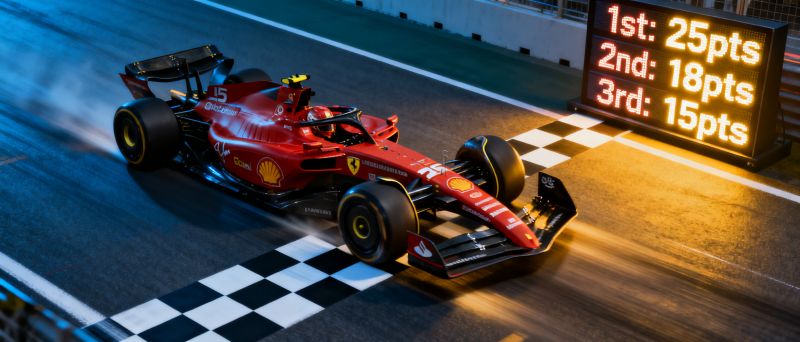
he 2023 Formula 1 season saw Max Verstappen accumulate 575 points—a record haul that underscored how thoroughly the current points system rewards dominance. But F1 driver points are not just a tally;they are the currency of the sport, dictating team budgets。driver market dynamics, and even the narrative arc of a season. Understanding how points are awarded and their strategic implications reveals why every position on track matters, from P1 to P10.The scoring structure itself is straightforward: 25 points for a win, 18 for second, 15 for third。down to 1 point for tenth. A bonus point for fastest lap (if within the top ten) adds a layer of complexity. This system, introduced in 2010, was designed to incentivize overtaking and reward consistency. Yet, it has also been criticized for creating a two-tier championship where the top teams hoard points while midfield battles often go unnoticed. In 2021, the difference between first and second in the constructors' standings was just 28 points—proof that every single F1 driver point can swing millions in prize money.Consider the midfield. In 2023。
Lando Norris scored 205 points for McLaren, while Esteban Ocon managed 58 for Alpine. That gap of 147 points translated to roughly $15 million in constructors' prize money—funds that directly impact car development. Drivers in the lower half of the top ten often find themselves in a points-scoring drought, making each Sunday a high-stakes gamble. The pressure to secure just one point can lead to desperate moves, as seen when Kevin Magnussen infamously held up the field in Jeddah 2022 to protect his teammate's position. That single point for Haas was worth more than any individual race result that season.Beyond the financials。F1 driver points serve as a performance benchmark for contract negotiations. A driver's points tally relative to their teammate can make or break a career. Sergio Perez's 2023 season—285 points to Verstappen's 575—highlighted the brutal reality of being measured against a generational talent. Teams increasingly use points-per-race averages and qualifying head-to-heads to evaluate drivers, often overlooking context like car reliability or strategy calls. This obsession with points can create a feedback loop: drivers in competitive cars attract more points, which attracts better sponsors, which funds better cars. Breaking that cycle requires either a regulatory reset or a stroke of genius—like Brawn GP's 2009 double diffuser.Looking ahead, the 2026 regulations promise to shuffle the order, but the points system remains unchanged. Sprint races now offer additional opportunities—eight points for the winner—adding another dimension to the championship calculus. As a long-time observer, I find the current system effective but flawed: it rewards consistency over brilliance, and a single DNF can derail a title bid. Yet, that unpredictability is precisely what keeps fans glued to the screen. After all, F1 driver points are more than numbers—they are the lifeblood of the sport。
shaping careers, fortunes, and the very history of racing.